A mind at war and the first part of a map for navigating other worlds
My mind is at war, but lately what keeps happening to me is that I'll start writing about
something and then the world goes and does a somersault, which leaves that something kind of
out of context and then I have to rewrite what I've written.
It has happened to me several times in the last months because the world won't stop doing
somersaults.
But even so, we want to talk to you about the Fediverse, so I think the best way to do that is by
starting with how social media alters our perception of reality.
For example, do you know who Dario Amodei is? Or Linus Torvalds? Or something more vintage,
like Ada Lovelace? For us it's general knowledge, even a conversation subject, but there are a
lot of close friends and family who have absolutely no idea who these people are.
We live in the same space and we're close to each other, but our realities seem different
because each piece of knowledge shapes a different vision of the world.
For instance, there are people who have no clue what the Epstein Files are, and when you bring
it up they look at you like "what have you been smoking?", but in other corners of the internet it's
THE topic of conversation.
Maybe you, reading this, have all of this figured out because we're more or less in the same
information "lane", but for most people their representation of the world is completely different
from yours and every day it worries us more how deeply this is affecting us as human beings.
As they said in The X-Files "There are many worlds, but they share the same sky."
And what is it that's modelling these realities and splitting our perceptions apart, even when
we're neighbours and we see, objectively, the same things? What leads us to understand the
same fact in such different ways that it can even push us to fight over it?
My algorithm isn't your algorithm (although yes, it's the same algorithm, you know what I
mean…), so the way news is presented to me isn't the same as the way it's presented to you,
which means my vision of reality isn't the same as yours, because even though a fact is a fact,
the way it's told to you can completely change how you understand it.
It is know, you know that, but we still see people arguing over stupid things, simply because
they dig into their bias, their social group, into what they're supposed to think because "look, I
saw Whoever say it on YouTube, and if Whoever says so, he knows a lot, there must be a
reason."
And then there's "ChatGPT says so" as incontestable proof of truth, but we'll talk about AI
hallucinations and the data they're trained on another time.
Algorithms are shaping our perception of reality and those algorithms are the property of private
companies. And the owners of those private companies have their plans, their political
interests (or ideas) and their opinions, which are, at the end of the day, only one part of the
whole.
Because they're people, right? And if all of us have a skewed reality, why wouldn't they?
A lot of information gets lost, because if from the start you "program" my access to reality by
deciding what I should see and what I shouldn't, it then fragments into a thousand tiny pieces,
leaving me only a minimal part that can lead me to misinterpret things.
Then they ask you for critical thinking while confusing you, rewarding obedience and trying to
make sure you don't really question anything too much… anyway.
Back then, when information reached us mainly through paper, or through TV and radio, it was
easy controlling the narrative. And with the internet, which is so vast and infinite, it might seem
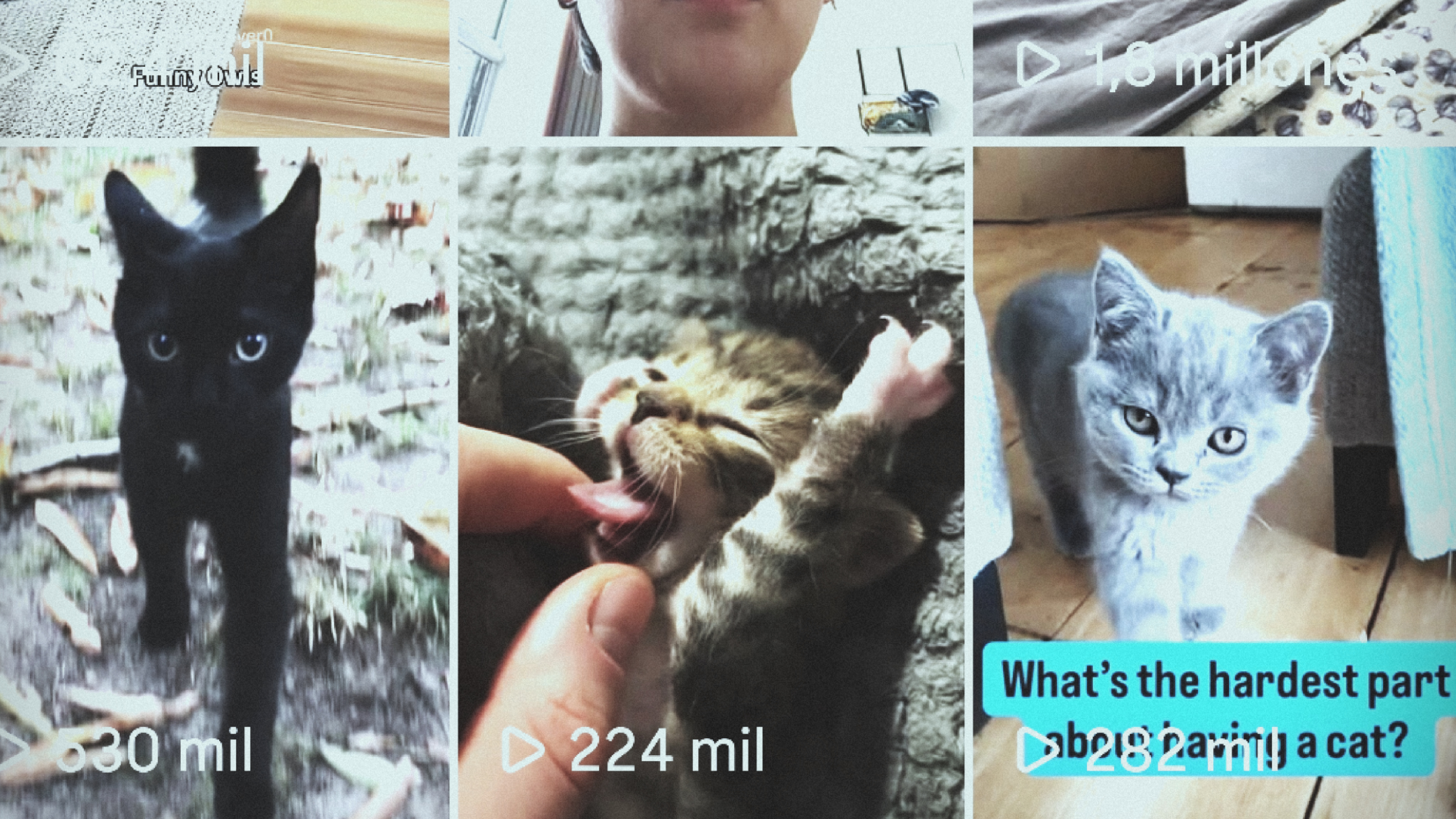
harder, but algorithms are brilliant at showing you the kitten video they know you like and they
will, in fact, show you every fucking kitten video in existence needed to distract you from
"problematic" ideas.
There was a time (too brief, for our liking) when the internet was an open world of free ideas
where you could find any information you wanted and then decide what you wanted to think,
how you wanted to interpret those facts and how you wanted to shape your view of reality. But
that, as you can imagine, was super "problematic."
Now, if you put certain keywords in a social media post, the algorithm will make sure no one
ever sees that post ever. In fact, that's why we named this post how we named it and have also
actively avoided using the word Fediverse, because if you put that word in any Meta network,
YouTube, etc., the algorithms will get very upset. (They've deleted a story or two on us before
for… potatoes. We're not going to get into evaluating that right now.)
What is clear is that if you really want to know what's happening on a particular topic, like the
armed conflicts we currently have on our hands, we strongly recommend reading different
sources to build a more complete picture.
Don't just go with what X or TikTok spits at you, or your usual newspaper or TV news. Look for
more. If you can, read newspapers from other countries, in other languages (most browsers
offer the option to translate any text from any language). Shape the ideas by putting the pieces
together yourselves to then reach whatever conclusion you want, but with as much information
as possible.
Skip Gemini's idiotic summaries and click on the actual websites. Read the full articles, not just
the headlines.
And we're telling you this, friend, because we believe it will keep you safe. Safe from making
decisions based on biased or incomplete information. Safe from fearing what isn't worth fearing
and from not fearing enough what is genuinely frightening.
Let's not let them lock us inside an echo chamber that tells us what we're supposed to think.
We have the right to information, to knowing the world we live in. We have judgment and there
are alternatives.
And that's where the Fediverse comes in, an alternative without algorithms (as understood in
this context).
First of all, it's important to remember that the internet (often idealized as something ethereal
and diffuse, almost magical) has a physical body, literally, in servers scattered across the
world.
You could picture the internet as an enormous floating city in a cloud, connected to physical
earth servers by cables, full of houses (websites), each with a door and an address (HTTPS),
running on traffic rules (TCP/IP protocol), where you (the user) get on your "cable/elevator" from
the server in your home PC or phone and you can travel there, enter the houses, see what's
inside, sit on the sofa, watch their TV or buy something.
That city has owners, like kings or feudal lords, who own those servers and who are large
companies like Google or Amazon.
So social networks would be like the "town square" of that city, with its market, its data lakes,
its arguments, people taking selfies, gossip and a lots of kittens.
Each social network has its own plot inside that square, but it's the same square in the end.
And those plots inside the square are called "centralized social networks" because everyone
goes there (even if they end up in different plots). And in this square, the big companies are the
ones who set the rules (sometimes for several plots at once), they put in the benches, they
watch the cameras, all of that.
That square (and its plots) is full of creatures that are part police, part salesmen and they
decide who sees what, who gets in where, who gets left in a corner with no friends, or what
you're allowed to talk about. Those are the algorithms.
These algorithms mean that even within the same plot, it's hard to find out what the stall next to
you has to offer, because they're constantly shouting in your face to get your attention and
make you buy things. You do run the risk of getting distracted and forgetting what you came for
in the first place.
Now let's look at the formal definition of "federated."
"Federated is an adjective that describes an entity, system or structure made up of
autonomous members or states that voluntarily associate, delegating part of their sovereignty
or powers to a common central authority, while retaining their independence and self-
governance for internal matters."
Right, well, the Fediverse is a federated system that also lives in the cloud, but in a different part
of the cloud.
Imagine it next to that city from before, for example, but instead of a city, it's an archipelago,
where each island connects to the others through bridges and has cables underneath
connecting it to the physical earth as well, just like the city. But in this case the cables are
smaller and there are loads of them. Why? Because unlike the centralized network of the city,
the Fediverse is a decentralized one, which means it's not owned by a few enormous
companies, but by thousands of people with their thousands of servers, each connected by
their own cables to different houses (Instances) built on those islands.
All the islands use the same traffic system, the ActivityPub protocol, different from the city's,
but it does more or less the same thing.
In the city square, even though there are different plots, everything is mixed together. You want
to buy fruit, but to get to the fruit you have to pass through clothing or tools. The algorithms
decide which stalls to put in front of you based on what you bought before. It's designed so that
you see what they want you to see before you get to what you actually want and they want you
to spend as much time there as possible, because they charge for showing you things and if you
stop paying attention, they can't justify their invoices.
In the Fediverse, you could say that each island has the name of a platform (Mastodon, Lemmy,
Pixelfed, others… etc.), and within each island, each house is a space (server) with a theme.
And who owns the platforms? Loads of people, the homeowners (which can be one person, a
group, a set of companies, a social movement… etc.).
Here, if you want fruit, you go to the fruit house and it's only about fruit. The owners set the rules
and if you want tools, you go to the tools house. And there are no algorithm-police/salespeople
telling you to buy tools if what you feel like is fruit.
When you sign up on a plot in the city, you're signing up for the whole mixed-up mess. But in the
Fediverse, you register in one house, though once you're "registered" you can visit the
neighboring houses no problem. Let's say you leave your toothbrush in one place and then go
for a stroll.
In the centralized city there are constant stimuli designed to hook you and it seems like it's free
there, but all of that is paid for with your data, which is sold to the highest bidder.
In the Fediverse archipelago there are no algorithms. You see what people publish in
chronological order, with nobody intercutting things you're not interested in.
And how is this archipelago funded? The people who run each house pay the server out of their
own pocket, or through donations from whoever lives there. Nobody gets rich, but nobody's
doing it for that either way, they do it to have a virtual world where they can share information,
art, comment on things, organize, build community… what the internet used to be, basically.
And yes, there are also loads of kittens.
So as not to drag this out too much, it's already a lot, we're going to leave it here for now as a
general overview of what the Fediverse is and in other blog posts we'll go deeper into its islands
and give advice on how to move between them, how to search by topic and more.
Also its pros and cons, because it has them, like anything that's still being built and depends on
so many people thinking at the same time.
But what the Fediverse does have at its core is that when you want to learn about a topic, there
are thousands of voices talking about it, each with their own opinion and without limits, making
you see things through thousands of different eyes. It's a free information ecosystem where you
decide what you want to know, for real.
The world is at war (and so are minds, a little), but there's still a lot left to navigate so don´t
forget to DREAM, CREATE, REBEL.
Join us on